
Tavern in the News: Matt and Jess Hit the Podcast Circuit
As Tavern steams ahead toward Election Day, our very own Matt Lackey and Jessica Reis both sat down for a pair of podcasts on the midterms, the future of campaigns, and how AI is reshaping how to win.
Matt, our founder and CEO, went deep with Nathaniel Pearlman on The Great Battlefield about the story of Tavern and how our machine turns our one of a kind dataset into the most effective ads in the business, while Jess, our Head of Research + Strategy, joined Joe Trippi on the Two Joes podcast to walk through the battleground map and talk about why Democrats can win in places like Kansas.
Matt on Tavern’s story
Matt founded Tavern inspired by “Attention Is All You Need,” the 2017 research paper that introduced the transformer, the architecture underneath essentially all of modern AI. The paper showed that machines could get dramatically better at understanding and producing language by learning which words to pay attention to, and reading it twice convinced Matt of what it meant for politics:
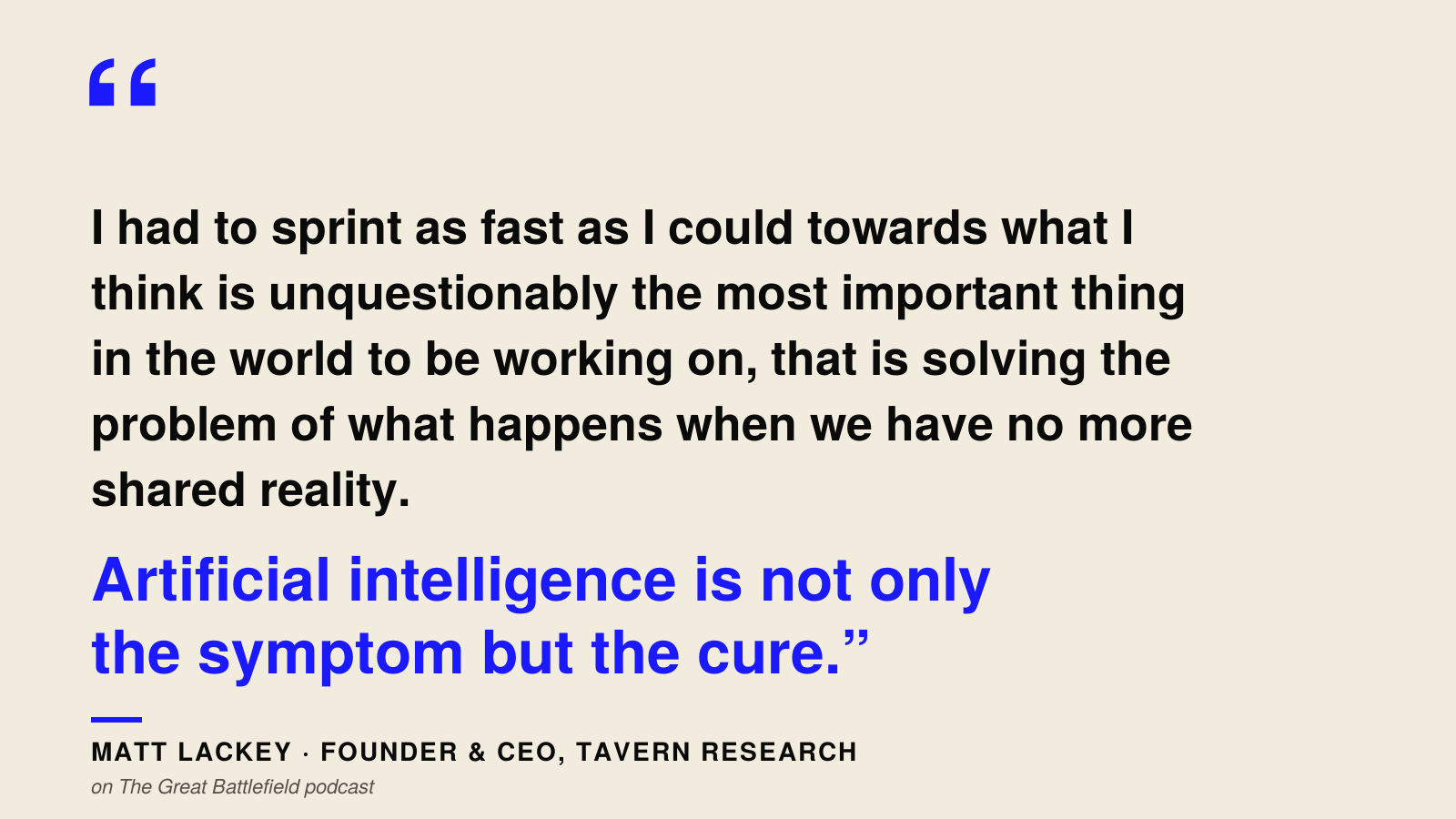
The flood of AI-generated content is coming whether anyone likes it or not, each feed tuned to keep each person watching whatever they already want to see, and a country that can’t agree on what’s real will struggle to govern itself.
Our bet is that the same technology driving that fragmentation is also the best tool we have for teaching, persuading, and rebuilding shared beliefs, and that the work has to start with elections, because leaders who answer to voters are the only ones with a real stake in keeping reality shared.
So at Tavern, we believe winning elections is how we make the world better. By combining best-in-class talent with revolutionary technology, we’ve built one connected machine that runs the studies, makes the ads, tests them, and places the buys. Our generation systems draft content at scale, Delphi scores every draft against the tens of thousands of messages we’ve already tested with real voters, randomized experiments pick the winners, and performance data shifts the money while the flight is still live. Every pass through that loop makes the next one smarter, and a campaign that starts with us today inherits everything the machine has already learned.
As Matt summed it up, “we are your ad shop, your polling shop and your ad placement shop all in one.”
That approach comes from the thesis we’ve built the company around: create, test, learn, win, repeat. The point of all that measurement is finding the new ideas that win rather than polishing the old ones, and as Matt put it, “we win by doing whole classes of new things.”
Jess on the battleground map
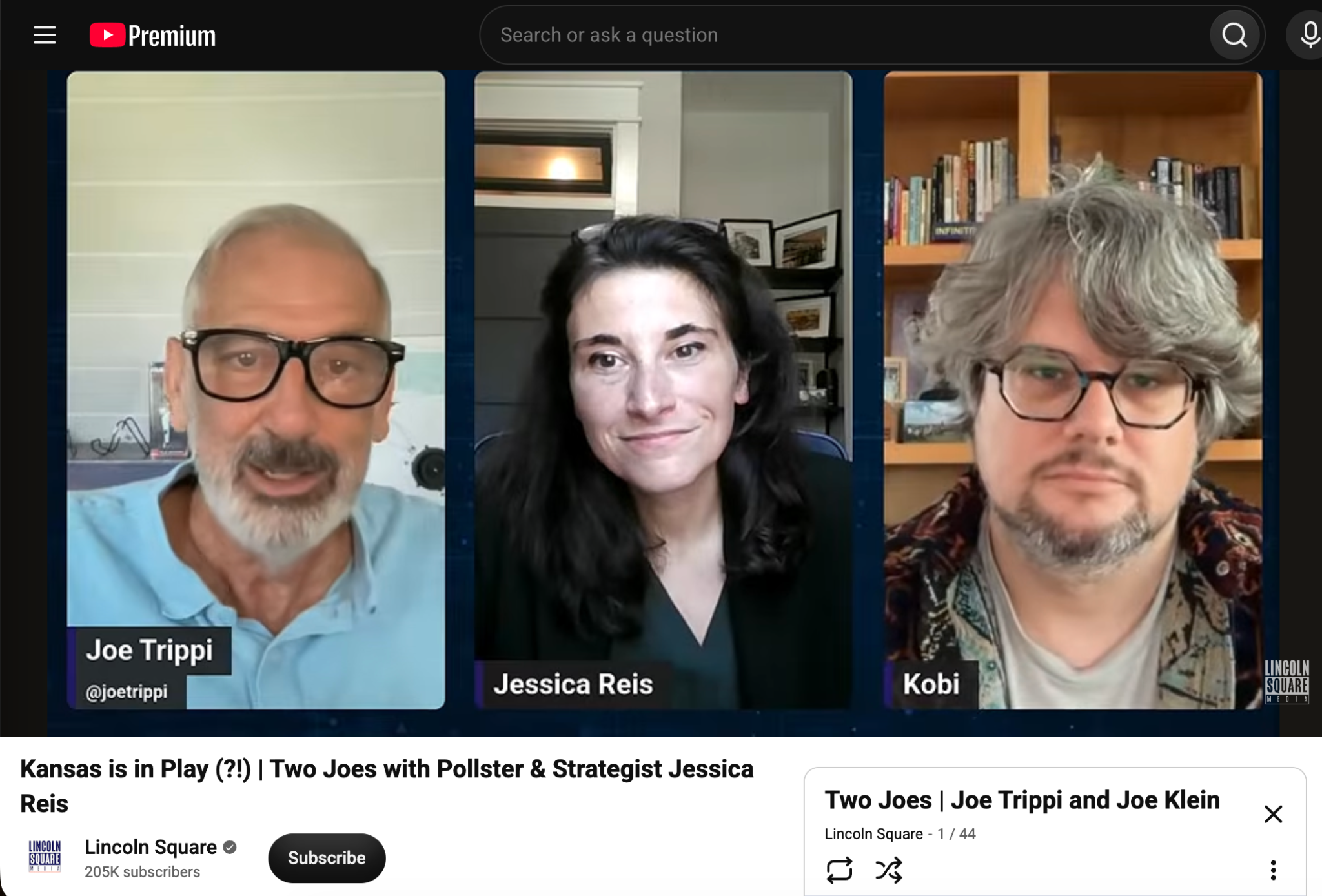
On the Two Joes Podcast, Jess argued that this cycle’s unusually wide map tells a story about campaigning, candidates, and the floor falling out beneath President Trump. Races in places like Kansas, Iowa, and Nebraska are competitive because several forces landed at once: weak incumbents out of practice at running real campaigns, strong Democratic recruits meeting the moment, and a war in Iran that voters squarely blame for what they’re paying at the pump and the grocery store. The coalition shifting underneath it looks nothing like the suburban wave of 2018, with rural, non-college, Obama-Trump voters giving Democrats another look.
She also laid out a theory of why the attacks that defined 2024 keep missing this year. Voters haven’t changed their minds on cultural issues; the context changed, because those attacks worked as an argument about the priorities of people in power, and now Republicans are the ones asking for another term.
As she put it, “the reason why [the 2024 culture war attack] was effective was because it was levied against people who were in power and it was about priorities. Now, with Trump and Republicans in power, they are ones who have the wrong priorities as prices rise and are now putting voters’ concerns first. It’s a misread of running the same playbook when the context is totally different.”
The flip side is what does work: the approach she calls dimensionalizing, weaving an incumbent’s record and conduct into one story about character, because voters judge candidates on “do I trust this guy to stand up for me” rather than on any single policy position.
What’s next
We’re working on a big new project in some of the most exciting battlegrounds in the country right now. Ads, ads, and more ads, placed in record time.
Stay tuned for more.
