
Ads Work. Better Ads Work Better.
Here are a couple phrases. See how many you can finish.
Silly rabbit, Trix are for ____
Like a good neighbor, State Farm is ____
Got ____?
Decades later, Americans across the country can still recite these on cue. Why? Good old fashioned television advertising.
Television ads are indelible, and they work, which is why companies obsessed with their bottom lines spend enormous sums of money on short videos to get you to buy things.
Because every company is advertising at once, the competition can hide just how powerful the effects are. But every so often one campaign breaks through and reorders an industry. In the 1980s the Pepsi Challenge, blind taste tests against Coca-Cola, was so persuasive that Pepsi passed Coke in market share for the first time in its history. And you knew the last word to all three of those phrases above.
The debate about TV ads
In commercial life, nobody argues about whether ads work. In politics, plenty of people do. It has become a kind of shibboleth that TV spending is wasteful and that a smart campaign puts its money into field operations or social media instead of TV advertising.
The trouble is the evidence keeps disagreeing. Take Wisconsin. Here is a map of Francesca Hong and David Crowley's primary results by county.
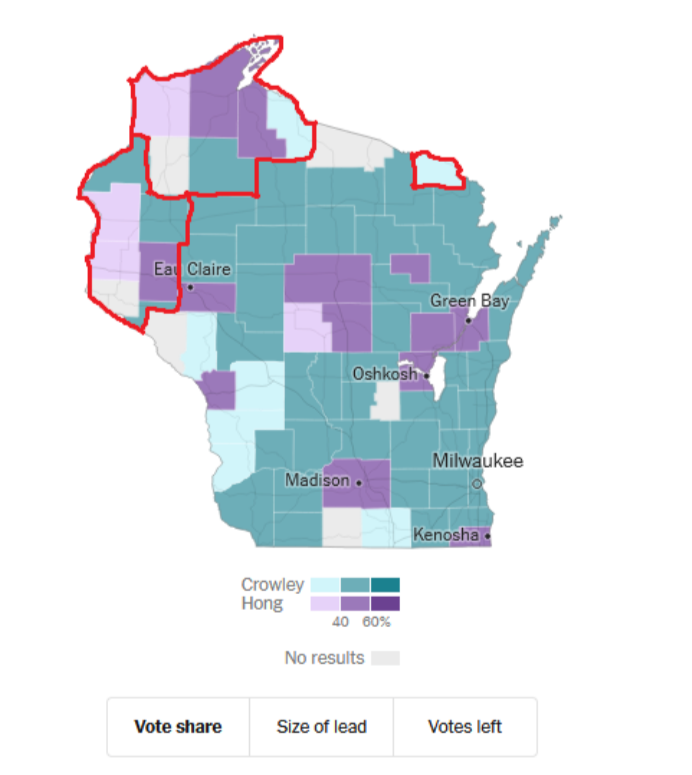
The red counties, where Hong overperformed, are the media markets where Crowley didn't run TV ads, mostly because the media markets they are in are based in Minnesota, across the border. Dan Rosenheck of The Economist ran the regression: being in a non-Wisconsin media market, meaning you never saw a Crowley ad, is associated with a 5.6-point improvement in Hong's margin.
That is about as clean a natural experiment as politics offers, and it lines up with everything we know.
What the research says
Most of the academic work comes from general elections, where ads should matter less than in primaries, and it still finds real effects.
Lynn Vavreck, John Sides, and Chris Warshaw used media-market border counties to isolate the effect of advertising. A three-standard-deviation spending advantage buys a Senate candidate about two points of margin, an attorney general candidate almost three, and a presidential candidate just 0.6, which makes sense since a presidential ad is competing with a flood of other news about the candidate. In dollars, their estimates land near $365 per vote in presidential races, $200 in Senate races, and $125 in a governor's race. A $10 million TV advantage in a Senate race buys tens of thousands of votes, more than the final margin in Nevada, Maine, Michigan, Wisconsin, or New Hampshire in 2016.
Jörg Spenkuch and David Toniatti found the same thing with their own border-county design: each additional standard deviation of ad advantage moved presidential vote share by half a point.
But not every ad is created equal
That's raw volume. And volume is only half the story, because some ads are forgettable and some are Jason Kander assembling a rifle blindfolded. So how much better are the good ones, and how would anyone know?
You run experiments, because intuition is useless here. When David Broockman and Josh Kalla tested it, they asked campaign staff to predict which ads would perform best. The pros were no better than random people off the street.
And the spread between ads is enormous. In another paper, Broockman and Kalla dug through a large archive of campaigns' own experiments and found massive variance in persuasiveness. Some ads did nothing. Some backfired. And some downballot ads moved vote choice by as much as 10 points of margin.
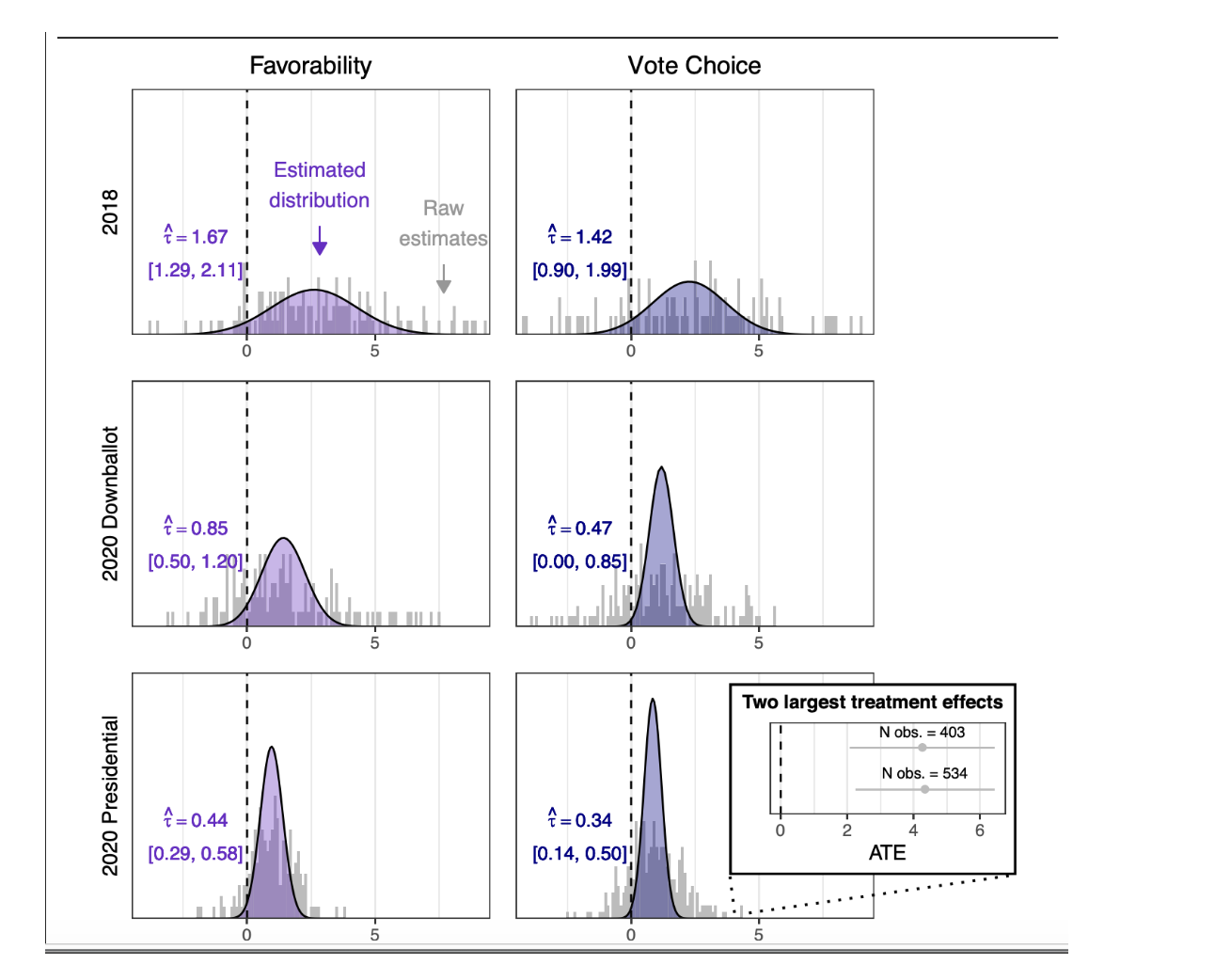
So here's the picture: money reliably turns into votes, and campaigns are reliably bad at knowing which ads will do it.
Where Tavern comes in
That paper concluded, correctly, that ad effects are hard to predict in advance. We agree, with one adjustment: they're hard to predict if you're guessing. We don't guess. We've run thousands and thousands of experiments and learned what's repeatable and consistent, which we've written about again and again. Context changes and novelty matters, so we keep running them, both to find the strongest ad for the race in front of us and to carry that learning into the next ad we make for the next client.
A campaign that has more money and figures out how to spend it on the best ads gets to magnify every effect above. The world we're trying to build is one where campaigns produce the most persuasive ads as cheaply and as quickly as possible, so that nearly every dollar goes into airing the ad instead of developing it and testing the message.
Ads work. Better ads work better. Email us and we’ll make sure you're airing the better ones.
