
AK-AL: Begich Leads Every Matchup. An Unknown Independent Runs Closest.
Nick Begich is ahead in all three head-to-heads. The candidate who gets closest is an independent 79% of voters can't place.
May 29, 2026 | 4 min read
Nick Begich leads all three ballot tests in Alaska's at-large district, and he never clears 55% in any of them. He beats independent Bill Hill 52-48, Democrat Matt Schultz 55-45, and a generic Democrat 55-45. The margin of error is 7.2%, so the Hill matchup is a statistical tie and the two Democratic matchups sit right at the edge of what this sample can call a real lead. Begich's lead is the headline. The more telling number is the shape of the vote against him: it consolidates better under an independent than under a Democrat.
Download the data: Toplines (PDF) | Crosstabs (PDF)
The Ballot Tests
Begich leads every matchup, but the size of the lead depends on who he is running against.
With a 7.2% margin of error, only the Hill matchup is inside the margin, so it reads as a tie. The two Democratic matchups land at 10 points, close enough to the line that this sample cannot lock them down as clean leads. Begich is the favorite in every matchup, and he has not put any of them away. These are forced-choice results: voters who first said they were undecided were asked which way they lean, so the figures carry no undecided column even though a real share of voters started there.
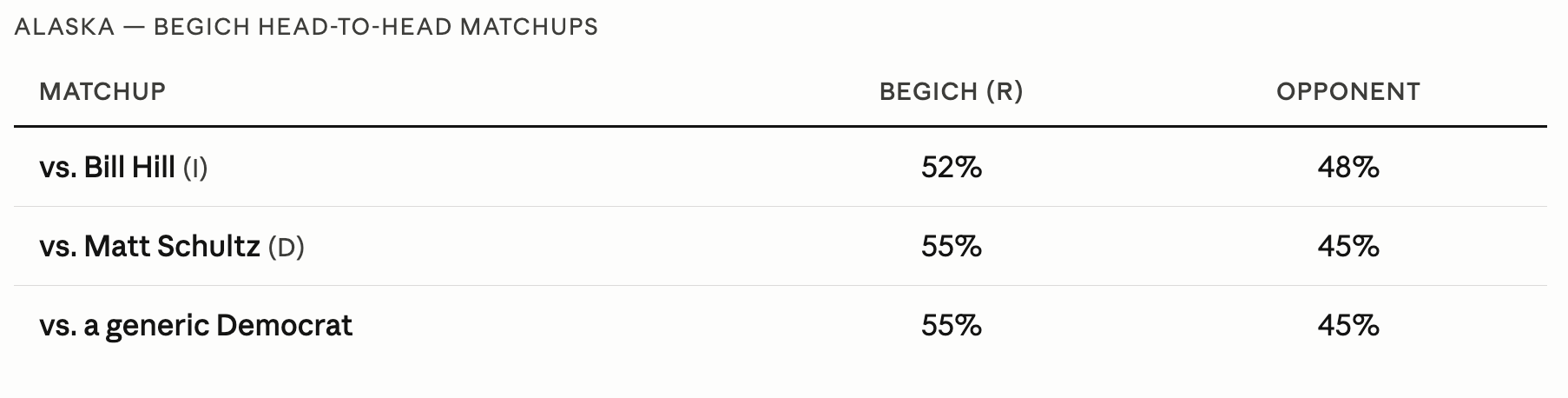
Bill Hill, An Unknown Independent Runs Closest
Bill Hill does better against Begich (48%) than Matt Schultz does (45%) and better than a generic Democrat does (45%). The gap is small. It also points the same direction every time we ask, and the reason sits in the independents. Among independents (n=219), Begich takes just 37% against Hill and 41% against Schultz. The independent label pulls a few more anti-Begich voters than the Democratic one does.
Who lives in this electorate explains why. 36% of these voters call themselves independents and only 16% call themselves Democrats. A Democrat starts from a smaller base and carries a party label that costs votes here, so the same anti-Begich vote reaches further behind an independent than behind a Democrat.
Here is the part we're still working out. Hill pulls 48% while 79% of voters say they have never heard of him or have no opinion of him. That 48% measures Begich's ceiling more than it measures Hill's strength. We don't yet know what happens to it once Hill becomes a real person to these voters, in either direction. We'll re-test once he's defined.
Favorability: Begich Is Defined, His Challengers Aren't
Begich is the only candidate voters actually know. His net favorability is +9 (50% favorable, 41% unfavorable), and just 10% have no read on him. That is a fully defined incumbent sitting in the low 50s, with a floor and a ceiling close together. Schultz and Hill both post positive net numbers, but those rest on tiny known universes: 65% can't rate Schultz, 79% can't rate Hill. Their favorability still has room to move in either direction, while Begich's is already close to settled.
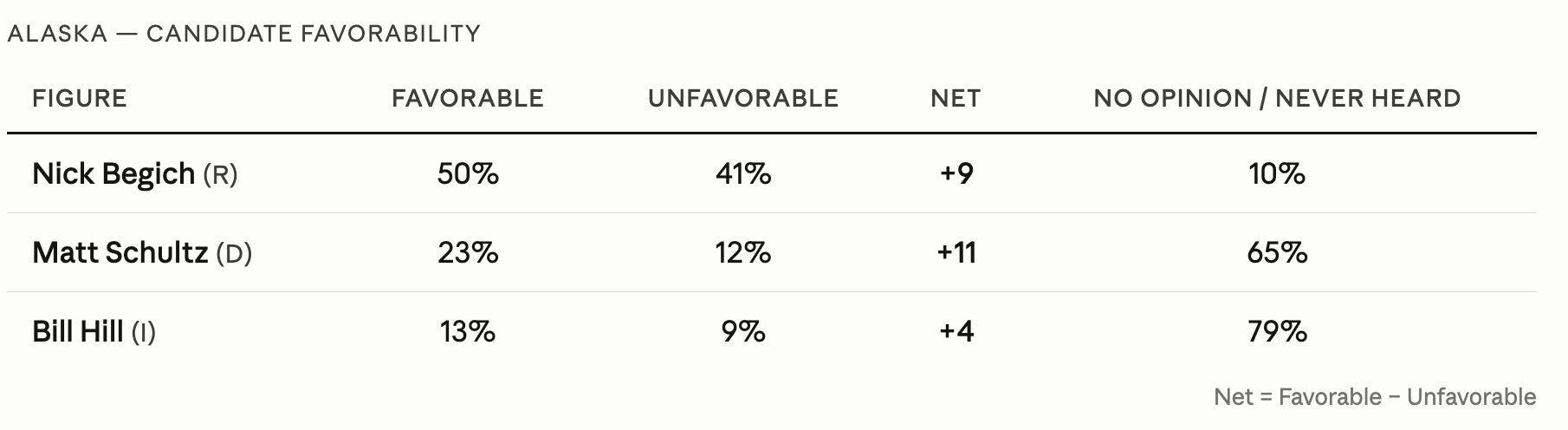
The Environment: Trump Is Underwater in a State He Won
Trump carried Alaska, and our 2024 recall puts him at 55% here among 2024 voters. His job approval right now is 47% approve, 52% disapprove, a net of -5, and his personal favorability is nearly identical at -6. Begich is a Republican running while the top of his party sits slightly underwater with the same voters who sent it to power. Among independents (n=219), Trump's approval is 30-69. Those are the voters who decide whether Begich gets to a real majority.
What's Still Open
The Hill matchup is a tie inside the margin, not a lead.
Hill's 48% rests on voters who can't identify him. It moves once he's defined.
Begich is the only candidate with a locked image, so his number is closer to a final number than anyone else's.
The honest read: Begich is ahead and fully defined, the anti-Begich vote is larger than any single opponent, and right now an independent collects more of it than a Democrat. Whether that holds depends on whether Bill Hill becomes real to voters before November.
Want district-level ballot testing for your race? Email data@tavernresearch.com →
Methodology: Online sample of 452 likely voters fielded over web panels from May 18, 2026 to May 27, 2026, weighted by gender, race, education, 2024 presidential vote, and age, and by whether respondents passed attention checks. Margin of error 7.2%. AI-assisted drafting, human-verified analysis. Powered by the same tools we build for our clients.
